 |
Here are only some of the articles I found online:
PC World
The Escapist
CrunchGear
The Atlantic
Blog Critics
And that's only sifting through the first three pages of a quick Google search. Nonetheless, this is only the tip of the iceberg. While I read through these select articles, I don't expect you to. Feel free to follow the links to the originals, but I offer the key points I took away from the readings below:
"Besides, the last thing you want to tell a gamer is what their medium can't be. Gaming by definition rails against that sort of arbitrary small-mindedness."-Matt Peckham, PC World
Peckham's pretty pissed. His response was a strong one and directly attacks Ebert's commenting on games without having played a lot of them. Also, he argues that Ebert is critiquing a TED talk, and essentially watching videos of games within a video. Finally, he denounces Ebert's use of definitive words like "never", and says he's channeling his inner Nostradamus. Peckham offers these games for consideration: BioShock ICO, Shadow of the Colossus, Heavy Rain, The Dark Eye, The Graveyard, Okami, and Grim Fandango. Peckham's response was short and to the point. I found it somewhat amusing.
"...art is subjective. There has never been a clear definition of what exactly 'art' is, and that's because it varies from person to person. There will never be a consensus on 'videogames as art.'
The Graveyard
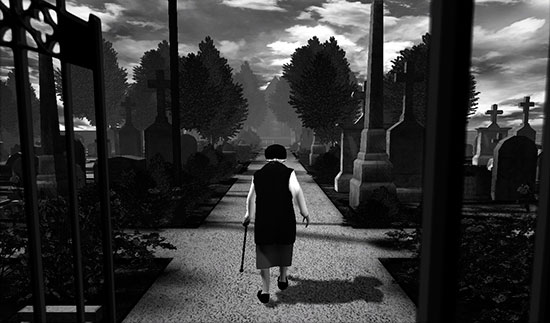
My personal definition of art is something that provokes emotional attachment. And there are games that have given me far stronger emotional feelings than any other story told in any medium. Fear, despair, joy, sympathy, the whole gamut."-Ben "Yahtzee" Croshaw, The Escapist
Croshaw begins by saying he respects Ebert, respects his opinion, and doesn't care to change it. He does poke at Ebert's claims and his credibility to comment on the gaming genre, but ultimately takes a "let bygones be bygones" approach. Croshaw offers his definition of art, and that he considers video games the greatest form of such a medium. Also, Croshaw makes the interesting point that as video games have evolved from the days of Asteroid, perhaps "games" has become a misnomer.
"Let’s not forget, Mr. Ebert, that movies weren’t always considered art. How could a movie tell a story as well as a novel? And surely a movie is nothing but a poor imitation of a play—who would sit in front of a screen to watch a lousy recording when they could sit mere feet away from the actor himself, live and in the moment?"
The main thing I took away from Deleon is the fact that movies/film went through the same struggle with becoming generally accepted as a form of art.
"...video games are nothing if not experiential. They are visuals and music and poetry all wrapped up into a single package. A video game isn't just a game—it is a controlled passage through an overwhelming aesthetic experience. This is also the basis for my own definition of art as any sensory aesthetic experience that provokes an emotional response in its audience, be it wonder, anger, love, frustration or joy. the sailing sequences in The Legend of Zelda: Wind Waker are worthy of comparison to Coleridge's Mariner. Pokémon is a coming of age story that doesn't pander or condescend to its young audience, a self-guided Catcher in the Rye. Miyamoto has said that he came up with the original Zelda game as a 'miniature garden that [gamers] can put inside their drawer.' Likewise, the endless castle of Super Mario 64 is certainly a 'world in a grain of sand'.
 |
| Catcher in the Rye? |
Video games allow us, as William Blake says, as children do, as Miyamoto does, to 'hold infinity in the palms of your hand and eternity in an hour.' The question is not if video games qualify as art, or if video games can stand up to the art of the past, rather, it is how to find a new language to speak of video games as art."
-Kyle Chayka, The Atlantic
Powerful words.. especially the last paragraph there. I found Chayka's comparison of Pokémon to Catcher in the Rye appropriate and fitting. I very much appreciated his choice of words in describing the gaming experience, and literally bringing some poetry to it. Chayka's main point seems to be that games are already art whether or not whoever recognizes it, it's only a matter of defining the "type" of art it is.
"When you get right down to it, everything is subjective. You can only truly view the world from your personal perspective. How then does something come to be accepted as true? The answer is consensus. A colorblind person would never truly know that the sky is blue, but they can accept that it is blue because so many other people have agreed upon that fact and the science behind it.
An individual may think Moby-Dick is trash and not worth reading. That is their subjective experience. However, you have to take into account that Moby-Dick has become a classic of American Literature — it has been studied and analyzed for years by scholars and academics. People have come to a consensus that it is a great book because of its masterful use of language, symbolism, and theme. Not everyone agrees, but that is nothing new. It is also interesting to note that Moby-Dick was critically reviled when it was originally released. Eventually, the best ideas float to the top.

...[games are] just entertainment, a diversion. I can’t stress that enough. That is what they are designed to be. I don’t require videogames to be more than entertainment. At the same time, I don’t require art to be entertaining."-Daniel Haymes, BlogCritic
Interestingly, Haymes is the only article of the bunch that agrees with Ebert. But that's not why I provided such a long passage from his writing. Mainly, I appreciated the fact that he was the only one to try to tackle how the subjectivity of art meets objectivity.
This article by Samantha Murphy in the NewScientist provides commentary by several people of the gaming world in response to Ebert's blog. I decided not to paraphrase because the entire article is composed of quotes.
Here's a book (looks like a textbook) written on the subject: Videogames and Art
No I have not read the book. It's kinda pricey for me.. that'd be a fun class to take though (if it is a textbook).
---
All of the quotes above speak for themselves. Take what you will from them. But mostly what these authors contribute to the discussion is not just their two-cents or insight, but clarification and definition on the topic. After reading through everything I definitely feel that the debate has taken a clearer form. I (personally speaking) have a better idea of how to define video games, art, the subjectivity in art, and how they fit together.
There were also various articles that explore how video games are art. Rather than arguing the "yes, no" part of the debate, these articles skip that step and try to uncover the art in games. I mean, in the end, that's what matters to the discussion, no? It's not about whether Roger Ebert was right or wrong. Or about getting an answer to the question. More so, it's about defining the art in games, or defining how games fit in the art world. And by doing so, we will realize how to treat games, how to think of games, and how to regulate games.
---
This article found in Kotaku summarizes an open panel that took place at The Art History of Games symposium in Atlanta, Georgia on Feb 5, 2010.
The panel was comprised of experts, including Ian Bogost, digital media scholar Michael Nitsche, and art historian and game designer John Sharp.
This is a very interesting discussion that I encourage you to read. It's not very long.
---
ok, so after looking at everything already in this post i've decided it's gotten entirely too long. therefore, i'll discuss Mr. Smuts and his paper in my final addition to this 5 part blog, along with my final take. i'll leave you with a list of other articles i found and read. the point i'm trying to get across is that many respectable people have chimed in on the debate. there's plenty of commentary and insight to be found and had. there's plenty to discuss, debate, argue, and as i've done.. indulge (or digest, depending on how you look at it).
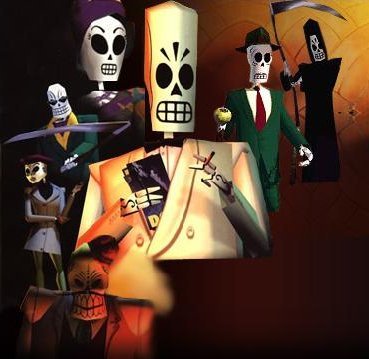 |
| Grim Fandango |
hopefully, i haven't completely failed. i think for the most part i've compiled a lot of the relevant commentary, with some "voices of the people" sprinkled in there. so, i think now my goal is to provide a (relatively speaking) comprehensive source of the "videogames as art" debate. like i said, hopefully i'm close to doing that. i will add some more of my personal take in part 5. but as promised, here's some more links to other articles (if anything, just to save you the time of googling for them yourselves):
GameCritics
a thorough article by Chi Kong Lui
World Of Stuart
provides reasons games simply aren't art:
"But videogames are like handing out boxes of crayons at the entrance of a gallery. If you can control the art, then you're influencing it, when the point is that it's supposed to influence you."
gives a fun "True Art Timeline"
LiveJournal
LiveJournal user Game Politics explores the topic
CNET
from the crave blog in CNET, Dan Ackerman's article
Destructoid
a fun take by Mikey Neuman, apparently asking the question is retarded
Blastr
provides a comment by actor Ben Kingsley, of Prince of Persia: The Sands of Time:
"'I think it's a beautiful field of work for graphic designers, inventors, actors, technicians,' Kingsley said... 'I have voiced a video game very recently, and I so enjoyed bringing that character to life and all the choices that he has in this game.'"


The American Scene
Peter Suderman says video games are more comparable to comic books than movies
Gamasutra
an article by Simon Parkin about film director Guillermo Del Toro's take (a strong one at that)
Parabasis
blogger Isaac Butler
Are You Screening?
by Marc Eastman
Games Are Evil
an in-depth analysis (so says the title) by Ammon Horn
Big Download
posted by Akela Talamasca
Cartoon Brew
by Amid
NxtGamer
Denis tries to define art. ends with:
"I love art and all, but I still like blowing stuff up."London Review of Books
John Lanchester adds his take. i agree with the end quote:
"The next decade or so is going to see the world of video games convulsed by battles between the moneymen and the artists; if the good guys win, or win enough of the time, we’re going to have a whole new art form. At a moment when there’s less good cheer than there should be, it’s something to look forward to."oh, there's plenty more.. but that's it from me.. feel free to go to page 4 in your google search
 |
| Heavy Rain |


No comments:
Post a Comment