PART ONE
 VS
VS 
I first came across this subject of discussion while reading an interesting article (at work) in the Dec 2010 issue (#212) of Game Informer, by Matt Helgeson (senior editor).
The article, titled "Video Games, It's Time To Grow Up" basically puts EA on blast for the way they handled (or mishandled- according to Helgeson) the controversial content in Medal of Honor. The controversy? To quote the article:
"...it was reported in the media that Medal of Honor's multiplayer component would allow gamers to play as Taliban forces - virtually gunning down U.S. and allied soldiers..."
Helgeson calls it a Call of Duty wannabe


EA defended itself in two ways,
#1 remind everyone it's just a videogame, and someone has to play as the opposition
#2 videogames are modern art, and therefore deserve artistic freedom
This controversy became an opportunity. An opportunity for the video game industry to make a little noise and take a step up and stand on the same level as its sister platform, film. And so, when response #2 was released by EA Games president Frank Gibeau, he made the right comparison when mentioning The Hurt Locker, and even threw in Red Badge of Courage (book) for good measure.
Alas, EA ultimately caved to the bad press and changed the name of the Taliban group in multiplayer play to "opposing force". A relatively quiet defeat for the gaming world everywhere. Helgeson goes on to list other examples of how the gaming industry is missing the boat on several occasions, and as a result, creating an inconsistent image of the industry. Then, he concludes with the fact that because the gaming industry sends mixed messages (on whether or not to take it seriously), it's no surprise the industry, not film or television, is preparing to defend its Constitutional right to freedom of speech before the Supreme Court.
---
 |
| you can't tell me games haven't come a long way. sure, kiddy games like mario will always be around. but there's a whole new kind of realism to games nowadays |
As a self-proclaimed "gamer" I couldn't help but wonder whether or not I played games for fun, just to pass the time, or did they carry some deep meaning and have an influence on my life? I can't deny that they've been a huge part of my life, I've been playing games since as far back as I can remember. I can tell you that games have definitely been able to invoke emotional responses from me. And there have been some great stories, with great messages, and beautiful aesthetics in various games I've played.
So, yeah, naturally, as I considered the issue I found myself getting defensive as a gamer. Of course, this activity that I've spent hours on end.. days on end.. months of my time doing, and/or watching someone else do, isn't just some meaningless, mindless, unprofound source of entertainment. Of course it was a form of art. Why can't it be the literature of my generation (I'm not saying books are dead, I mean look at Kindle sales!)? Or at least for a part of my generation? Instead of the classics and Charles Dickens, we have the classics and Infinity Ward.
I didn't understand how it would be difficult for people to see the parallels between video games and other forms of art. Books tell stories, send messages, invoke emotion, and entertain us. Paintings, sculptures, and decorative art are appreciated for their aesthetic attributes. Games can contain breathtaking visuals. Digital art is now a recognized form of art, and it seems only natural that video games fall under the same category. It just didn't make sense how video games can't be all those same things that books, paintings, and sculptures are. Are not at least some of the great stories told by video games poetic (and therefore artistic) by some measure?
The article by Helgeson was a good read. It got me thinking. And more importantly, passed the time at work. Well, I quickly became bored again soon thereafter. And for some reason I found myself thoroughly intrigued by the Video Games vs. Art debate. I couldn't shake it that I actually cared about having an Answer to this Question. In the article Helgeson mentioned Roger Ebert making the daring statement that video games are not, cannot, and will not ever be considered art. At this point, despite my initial inclination to defend my inner-gamer, I realized I'd only seen one side of the argument. I decided I wouldn't be so quick to make up my mind until I did some more research.
Next, Mr. Ebert's take on the matter..

---
PS. a final note before I conclude my first post.. WHY DO I CARE ???
it seems, after some Googling, that a lot of detractors of Mr. Ebert's comments, or the debate in general, ask the question:
WHO GIVES A - FLYING ****/ RAT'S *** / TWO ***** ???
and it's simple. i do. you should. why? the same reason we care about anything else. it's out there. games are everywhere now. we all play games. from WiiFit, to Kinect, to iPad/iPhone/iPod apps, tetris, solitaire... at parties, even work parties, we find ourselves around DDR/Rock Band/WiiSports...
personally, most of the friends i have play games. it's less common to meet a guy around my age range who doesn't play games in some way, shape, or form. instead of trading emails, or phone numbers, or Facebooking, or s/n's, i find myself trading gamertags.
and if you don't have a personal affinity for gaming, guess who does? your friends, your siblings, your kids, your kid's friends... A LOT OF PEOPLE PLAY GAMES.
the gaming (..comic book, Saturday morning cartoons, etc.) generation has grown up, and we've produced the technology to keep up. what else could explain huge blockbuster record breaking movies like Spider-Man, X-Men, Prince of Persia (ok, well at least there were a lot of commercials on tv).
my point is, gaming is another form of pop culture/media that surrounds you whether you know it or not.
 |
| this is no longer the ONLY image of what gaming looks like anymore. a lot of us older folks are jumpin in on the action still. doing only what we've always done since we were little like these two boys. the only difference now is we can afford to pay $600 for a console, $60 a game, and $x amount for accessories (bluetooth headset). |
so you should care.
as a gamer, i fear that my gaming experiences might be limited by regulations and censorship...
as a potential father, i'd like to know how strong the correlation between kids shooting each other in schools and violent video games is...
so yes, i care.
it's tragic, but a lot of decisions are financially motivated.. much like EA's decision to back down, some of the gaming industry's respected individual's have encouraged gamers to forget about the great debate and just. game. on. my thought is that they probably think most of us gamers are simple-minded creatures who just want to blow stuff up. it's easier on sales if we don't think about it, and just keep playing. but i think it's an important enough conversation to be had.. so i started this blog.
PART TWO

My last post ended saying I would go over Roger Ebert's contribution to the debate. Which I will. Just not right now. Because of the length of Ebert's comments, and the number of comments left on his post. It takes a while for my work computer to even pull up the post. In fact, my machine has crashed more than once while trying to view the page. So, I'll hold off on it. Also, it will take a lot more time to cover everything he said, and provide thoughtful remarks in response. Finally, Ebert's comments are easily the most talked about in the great debate, and so they lead to much more.
In the meantime I wanted to briefly touch on a few things before writing that up.
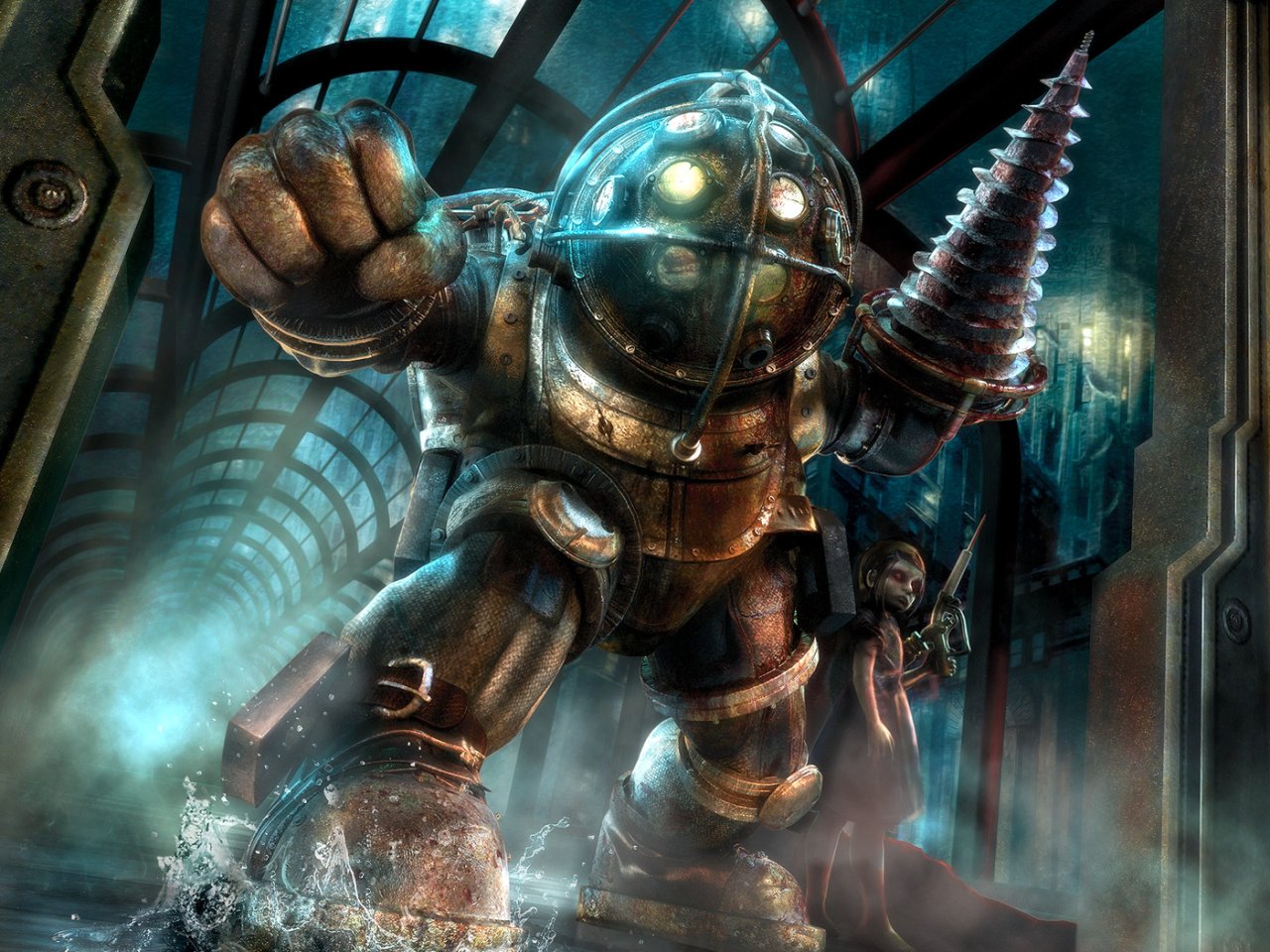
-Hideo Kojima (creator of Metal Gear Solid):

Kojima's message? Games are like a service, not art. Games are like a car, not art.
---

So, here we go again: Who Cares? Just play games if you want, and if you don't want to, don't. Right? Why is there a need to legitimize gaming?
My answer: I consider gaming to be the great medium of "our" time. This time. This era. I believe gaming is only nearing the end of its infancy, and yet, gaming has already become a powerful way to tell stories, send messages, teach morals, learn consequences.
Much like how we appreciate art, or we immerse ourselves in movies for a couple of hours, gaming can provide us with a similar yet more powerful experience (imo).
To be honest, my personal jury (in my head) is still out for a definite answer (despite what it might sound like above). I'm merely emphasizing why I think it's important to have the discussion. Rather than fixate on- IS IT ART, OR ISN'T IT ART?
So forget all that philosophical mumbo jumbo. Why does it matter to you as a person? How will it effect you personally? I glossed over that in my last post. But here it is again:
 1) Gamers. Censorship gets it easy. How dare we cover the mouths of the great artists of our time? (at least not without taking the proper time to think about it first..)
These are my initial reasons. I'm sure there are more. Whether or not the Answer is yea or nay, I believe if there is a debate, there's usually a reason for it. And if it's been going for this long (since the early 2000's) then it must be important. It seems the masses for the most part have given up or grown tired of the topic. Which is okay. Because that means we've exhausted the issue. Voices have been heard. Things have been considered.
so you should care.
as a gamer, i fear that my gaming experiences might be limited by regulations and censorship...
as a potential father, i'd like to know how strong the correlation between kids shooting each other in schools and violent video games is...
so yes, i care.
it's tragic, but a lot of decisions are financially motivated.. much like EA's decision to back down, some of the gaming industry's respected individual's have encouraged gamers to forget about the great debate and just. game. on. my thought is that they probably think most of us gamers are simple-minded creatures who just want to blow stuff up. it's easier on sales if we don't think about it, and just keep playing. but i think it's an important enough conversation to be had.. so i started this blog.
PART TWO
My last post ended saying I would go over Roger Ebert's contribution to the debate. Which I will. Just not right now. Because of the length of Ebert's comments, and the number of comments left on his post. It takes a while for my work computer to even pull up the post. In fact, my machine has crashed more than once while trying to view the page. So, I'll hold off on it. Also, it will take a lot more time to cover everything he said, and provide thoughtful remarks in response. Finally, Ebert's comments are easily the most talked about in the great debate, and so they lead to much more.
In the meantime I wanted to briefly touch on a few things before writing that up.
---
For now, I wanted to share a couple of comments made by gaming industry notables:
For now, I wanted to share a couple of comments made by gaming industry notables:
"Remove the beret from your head... toss your copy of Aristotle's Poetics... Crack open a two liter of Mountain Dew. Snap into a Slim Jim. Proceed to Xbox Live and shoot your best friend in the head with an M-16."
Levine's message? Forget about it. Those who don't get it don't have to. Matter of fact, you don't even have to get it. Just do what you like.
"If 100 people walk by and a single person is captivated by whatever that piece radiates, it's art... But videogames aren't trying to capture one person. A videogame should make sure that all 100 people that play that game should enjoy the service provided by that videogame... it's like a car where you have to drive it. There are 100 people driving a car; they have 100 ways of driving it and using it... so in that sense, it's totally not art."
Kojima's message? Games are like a service, not art. Games are like a car, not art.
---
So this is what I was talking about in my last post. Most of what I have read from the gaming industry side has been: don't think twice about it. Just keep mashing the trigger button like a mindless zombie (aka Just keep buying games and it doesn't really matter to us). Well, to be fair, I think Levine is really trying to side with gamers by saying "don't let the way other people think effect what you like to do".
 |
| Zombie |
On the other hand, Kojima didn't dodge the issue at all. He flat out said: it's Not. Which I appreciate and commend. Even though his opinion seems kind of silly (maybe lost a little in translation?), at least he addressed the issue directly.
Both of these guys are considered two of the great story-tellers of the gaming world. They've created masterpieces that are comparable to stuff we see out of Hollywood. In fact, Levine's career began as a screenwriter/playwright, and it is well-documented that Kojima's love of film has had a strong influence on his work. According to Levine, BioShock was inspired by the works of Ayn Rand. The game (a far cry from the experience he describes in his quote) is intricate and suspenseful, while thought-provoking and emotional. It is a shame he chose not to defend his work more directly.
There have been strong rumors suggesting that there will be a Metal Gear Solid live action movie to be released in the near future (as you can see, gaming is starting to reach further and further into other genres).
Point is.. these guys are well-respected.
I just wanted to share some other perspectives... More to come.
---
Point is.. these guys are well-respected.
I just wanted to share some other perspectives... More to come.
---
So, here we go again: Who Cares? Just play games if you want, and if you don't want to, don't. Right? Why is there a need to legitimize gaming?
My answer: I consider gaming to be the great medium of "our" time. This time. This era. I believe gaming is only nearing the end of its infancy, and yet, gaming has already become a powerful way to tell stories, send messages, teach morals, learn consequences.
Much like how we appreciate art, or we immerse ourselves in movies for a couple of hours, gaming can provide us with a similar yet more powerful experience (imo).
To be honest, my personal jury (in my head) is still out for a definite answer (despite what it might sound like above). I'm merely emphasizing why I think it's important to have the discussion. Rather than fixate on- IS IT ART, OR ISN'T IT ART?
So forget all that philosophical mumbo jumbo. Why does it matter to you as a person? How will it effect you personally? I glossed over that in my last post. But here it is again:
1) Gamers. Censorship gets it easy. How dare we cover the mouths of the great artists of our time? (at least not without taking the proper time to think about it first..)2) Parents. Does it really numb your kids to reality? Or is it a healthy way to learn life's lessons? Does it make you shoot up your school?
3) People. Gaming is everywhere. You can't run from it. No. Really. You can't run. Just wait till this generation's children grow up... You'll see.
These are my initial reasons. I'm sure there are more. Whether or not the Answer is yea or nay, I believe if there is a debate, there's usually a reason for it. And if it's been going for this long (since the early 2000's) then it must be important. It seems the masses for the most part have given up or grown tired of the topic. Which is okay. Because that means we've exhausted the issue. Voices have been heard. Things have been considered.
 |
| really? |
But consider this then: even chess, aesthetic sports (gymnastics, etc.), as an example, have been debated by philosophers of art to garner "Art" status. Unlike film, photography, literature, etc.. video games have been largely ignored. Which is why this keeps happening..
PART THREE
-- Shadow of the Colossus was the most often mentioned as being considered a "masterpiece" of gaming. Myst, and Cosmology of Kyoto rounded out the top three nominees, which are the two he decided to test drive. RE claims he actually really enjoyed Cosmology, while he didn't have the patience for Myst.
-- RE goes on to find a suitable definition for Art that would exclude video games. He concludes with this:
PART THREE
Ok, Finally. Mr. Ebert.
 |
from cave paintings |
 |
| to the Sistine Chapel |
I want to begin by offering my thanks to Mr. Ebert. From what I have seen online, it is because of Mr. Ebert that the video games as art debate has received as much coverage as it has. The majority of articles you will initially find are either in response to his comments, or reference them in some fashion.
It all began back in 2005 when Roger Ebert said on his website:
"Video games by their nature require player choices, which is the opposite of the strategy of serious film and literature, which requires authorial control.
I am prepared to believe that video games can be elegant, subtle, sophisticated, challenging and visually wonderful. But I believe the nature of the medium prevents it from moving beyond craftsmanship to the stature of art. To my knowledge, no one in or out of the field has ever been able to cite a game worthy of comparison with the great dramatists, poets, filmmakers, novelists and composers. That a game can aspire to artistic importance as a visual experience, I accept. But for most gamers, video games represent a loss of those precious hours we have available to make ourselves more cultured, civilized and empathetic."
Moving on, here's the link to his follow up blog post. It's not a long post and it's a fun read if you have the time. It takes forever for my work computer to pull it up though because of the 4819 comments and counting. This is the first of two of his posts I want to cover. (btw, it wasn't until April 2010 that he decided to revisit the issue)
So let's dissect what he said (summarized & very-much-so simplified):
-- Ebert basically summarizes a TED talk given by Kellee Santiago at USC <-- good stuff !! i'll provide a link to the TED talk later on.. my work blocks most video sites =/
-- here are a few quotes I picked out from Ebert's blog:
"Let me just say that no video gamer now living will survive long enough to experience the medium as an art form...
Santiago concedes that chess, football, baseball and even mah jong cannot be art, however elegant their rules. I agree. But of course that depends on the definition of art. She says the most articulate definition of art she's found is the one in Wikipedia: 'Art is the process of deliberately arranging elements in a way that appeals to the senses or emotions.'...
 |
| Death of Socrates |
One obvious difference between art and games is that you can win a game. It has rules, points, objectives, and an outcome. Santiago might cite a immersive game without points or rules, but I would say then it ceases to be a game and becomes a representation of a story, a novel, a play, dance, a film. Those are things you cannot win; you can only experience them...
No one in or out of the field has ever been able to cite a game worthy of comparison with the great poets, filmmakers, novelists and poets."
---
Alright, so RE (Roger Ebert) begins his post by rescinding his previous claim that video games will NEVER be art. He changes his opinion to: Maybe, just maybe, games might be art someday. But none of us alive now will be around to see it if it ever happens.
His main points of argument (again, simplified) seem to be that:
1) There aren't any games in existence that are worthy of comparison with great poets, filmmakers, novelists, dramatists, composers, painters, sculptors, etc.
2) games require player control/decisions.
---
Here's the second blog post. He put this up in July of 2010. RE felt compelled to add to his initial post because he received such a large response. This second post has received 1594 comments.
IMO, this is the better read of the two. Simply because he gives a lot more of his two cents, and it seems he put a lot more thought into this one.
-- RE begins by admitting that he never should have commented on gaming without having experienced it himself (having never played a game before and refusing to do so). Apparently, by the time of his writing the July post, he decided to play a couple of games that were consistently referenced by people commenting on his April post.
-- Shadow of the Colossus was the most often mentioned as being considered a "masterpiece" of gaming. Myst, and Cosmology of Kyoto rounded out the top three nominees, which are the two he decided to test drive. RE claims he actually really enjoyed Cosmology, while he didn't have the patience for Myst.
 |
| Myst |
-- Then, RE references a debate he had with filmmaker and game auteur, Clive Barker, on games and art. You can read it here. Barker attacks RE on his argument that art cannot have a certain amount of "malleability in the narrative". Or, in other words, that player choices take away from artistic value. Barker instead takes the stance that art can be an unique experience different for each individual.
 |
| Shadow of the Colossus |
 |
| Cosmology of Kyoto |
-- Then, RE references a debate he had with filmmaker and game auteur, Clive Barker, on games and art. You can read it here. Barker attacks RE on his argument that art cannot have a certain amount of "malleability in the narrative". Or, in other words, that player choices take away from artistic value. Barker instead takes the stance that art can be an unique experience different for each individual.
-- RE goes on to find a suitable definition for Art that would exclude video games. He concludes with this:
"I thought about those works of Art that had moved me most deeply. I found most of them had one thing in common: Through them I was able to learn more about the experiences, thoughts and feelings of other people. My empathy was engaged. I could use such lessons to apply to myself and my relationships with others. They could instruct me about life, love, disease and death, principles and morality, humor and tragedy. They might make my life more deep, full and rewarding.
Not a bad definition, I thought. But I was unable to say how music or abstract art could perform those functions, and yet they were Art. Even narrative art didn't qualify, because I hardly look at paintings for their messages. It's not what it's about, but how it's about it. As Archibald MacLeish wrote: A poem should not mean, but be.
I concluded without a definition that satisfied me. I had to be prepared to agree that gamers can have an experience that, for them, is Art. I don't know what they can learn about another human being that way, no matter how much they learn about Human Nature. I don't know if they can be inspired to transcend themselves. Perhaps they can. How can I say? I may be wrong. but if I'm not willing to play a video game to find that out, I should say so. I have books to read and movies to see. I was a fool for mentioning video games in the first place."
---
i'm going to try to keep this short and sweet because this post is already filled with copy and paste. also, i plan on giving my final thoughts in part 5 anyway (which means there will be a part 4).
part 4 will review the many articles and responses to RE's blog, as well as a paper written on the issue.
anyway, scrolling through the comments of his july post, you'll find that several comments commend RE on revisiting the topic. i wish to do the same. he could have easily ran away from the mob of gamers that he awoke and disappeared back into the world of film. but instead he tried his best to take us gamers head on and even did something he never wanted to (and said he never would)... play a game. i thank you mr. Ebert for your courage.
after reading through RE's blog and some of the comments, RE's debate with Barker, watching the TED talk, and articles and articles... i've generally seen that people have grown tired of the debate (RE included). the reason being that it feels like we'll never reach a definitive answer. which is always the case when entering a philosophical debate.. but the general public will mostly have a knee jerk reaction, and forget about it.
i mean, of course the debate feels hopeless. how can we figure out if something is something else if we can barely agree on what the something else is? art, has many definitions. in just reading RE's blogs you're provided with several of them. One from wikipedia, one from the dictionary, one from RE, Barker, Plato and Socrates, etc. i've chosen to stay away from defining art because that's a whole other ball of wax.
what i'm choosing to focus on is the discussion. because by talking about it, it has the potential to be. at least one day. the way we think about paintings, literature, sculptures, poetry, plays, photos, music, etc, most of us don't question that these things are art. they just are art. at least in our minds. one day, we'll know whether or not we think about games as art. the only way to get there is to keep thinking about it (as a society), keep talking about it.
a friend of mine and i always used to have this argument: is art subjective or objective? i would say art is in the eye of the beholder. i could look at some scribbles on a piece of paper and consider it beautiful.. but to him, it might look like scribbles. what he says, is that the mona lisa is the mona lisa for a reason. good art is good for a reason. he believes that it's not up to each individual. meaning, if something is determined to be a masterpiece, like the mona lisa, it's decided by the experts. and the mass public merely follows along. but then, one might argue, an average joe can look at the mona lisa and say, it's ugly, it means nothing to me, it's not good art, or even, it's not art at all. my buddy would say to this person: "you're an idiot".
so is art subjective? up to each of us? or objective? it just is. or isn't? who knows, again, that's a whole other discussion i'd rather not get into. too much typing. and not enough time at work..
well while we're at it. let's say it is objective. who are these supposed experts? who gets to decide what's art and what's not? who gets to decide what's good art and what's bad art? well, for now, i'm saying, who cares?
cuz when it comes to games, it's clear that games aren't at the paintings, literature, sculptures, etc level. i would say for now (to us-i'm speaking in general here) it's somewhere inbetween. like i said before though, i still think games are in their infancy, and have a long way to go. kinda like how cave paintings evolved to works like the sistine chapel (as mentioned in RE's blog and originally by Santiago in the TED talk). games have a long way to go too. maybe some day we will think of games as art without giving it a second thought.
look at how much games have already evolved. last year brought us kinect, the ability to play games without holding anything at all (sorry sony but move is just a glorified wiimote- but i will say that sony was first to release this technology with the playstation eye, microsoft just perfected it..)
look at how much games have already evolved. last year brought us kinect, the ability to play games without holding anything at all (sorry sony but move is just a glorified wiimote- but i will say that sony was first to release this technology with the playstation eye, microsoft just perfected it..)
 |
| what i do? |
you can go to modern art museums and see all kinds of weird stuff being passed off as art. a lot of those things you might question too. like i've once seen a looping cartoon video of OJ Simpson's trial on a tv set in a museum.
digital art is a whole new realm. in fact, video games are already making their way into museums too.
and i don't mean some random traveling road show. no, i'm not driving around with my ps3 in the trunk.
games are about to be in the smithsonian in 2012. i can't wait to go check it out. i'm curious what they might have. will they have games to play? will they show clips of games? or will they just have screenshots? maybe game inspired art? here's an article about the exhibit
game inspired art- they already have an exhibition like this every year at: i am 8-bit
 |
| PacMan Art |
also worth mentioning: into the pixel at the electronic entertainment expo (E3)
 |
| Turok Art |
what i've been saying is the content and creation process of games could be compromised by censorship and regulations.
but hey, maybe games aren't art, maybe they're just games. for fun. or at least, maybe they shouldn't be treated as art. that could be dangerous o_0. maybe they're making our kids too violent. maybe we should censor them, and restrict their sale to minors. who knows... only time will tell.
part 4 next
PART FOUR
This installment will be dedicated to the various responses Roger Ebert received, as well as a paper written by one Aaron Smuts. I don't know who Mr. Smuts is, but I found his paper online and found it interesting.
Here are only some of the articles I found online:
PC World
The Escapist
CrunchGear
The Atlantic
Blog Critics
And that's only sifting through the first three pages of a quick Google search. Nonetheless, this is only the tip of the iceberg. While I read through these select articles, I don't expect you to. Feel free to follow the links to the originals, but I offer the key points I took away from the readings below:
Peckham's pretty pissed. His response was a strong one and directly attacks Ebert's commenting on games without having played a lot of them. Also, he argues that Ebert is critiquing a TED talk, and essentially watching videos of games within a video. Finally, he denounces Ebert's use of definitive words like "never", and says he's channeling his inner Nostradamus. Peckham offers these games for consideration: BioShock ICO, Shadow of the Colossus, Heavy Rain, The Dark Eye, The Graveyard, Okami, and Grim Fandango. Peckham's response was short and to the point. I found it somewhat amusing.
Croshaw begins by saying he respects Ebert, respects his opinion, and doesn't care to change it. He does poke at Ebert's claims and his credibility to comment on the gaming genre, but ultimately takes a "let bygones be bygones" approach. Croshaw offers his definition of art, and that he considers video games the greatest form of such a medium. Also, Croshaw makes the interesting point that as video games have evolved from the days of Asteroid, perhaps "games" has become a misnomer.
-Nicholas Deleon, CrunchGear
The main thing I took away from Deleon is the fact that movies/film went through the same struggle with becoming generally accepted as a form of art.
-Kyle Chayka, The Atlantic
Powerful words.. especially the last paragraph there. I found Chayka's comparison of Pokémon to Catcher in the Rye appropriate and fitting. I very much appreciated his choice of words in describing the gaming experience, and literally bringing some poetry to it. Chayka's main point seems to be that games are already art whether or not whoever recognizes it, it's only a matter of defining the "type" of art it is.
Interestingly, Haymes is the only article of the bunch that agrees with Ebert. But that's not why I provided such a long passage from his writing. Mainly, I appreciated the fact that he was the only one to try to tackle how the subjectivity of art meets objectivity.
This article by Samantha Murphy in the NewScientist provides commentary by several people of the gaming world in response to Ebert's blog. I decided not to paraphrase because the entire article is composed of quotes.
Here's a book (looks like a textbook) written on the subject: Videogames and Art
No I have not read the book. It's kinda pricey for me.. that'd be a fun class to take though (if it is a textbook).
---
All of the quotes above speak for themselves. Take what you will from them. But mostly what these authors contribute to the discussion is not just their two-cents or insight, but clarification and definition on the topic. After reading through everything I definitely feel that the debate has taken a clearer form. I (personally speaking) have a better idea of how to define video games, art, the subjectivity in art, and how they fit together.
There were also various articles that explore how video games are art. Rather than arguing the "yes, no" part of the debate, these articles skip that step and try to uncover the art in games. I mean, in the end, that's what matters to the discussion, no? It's not about whether Roger Ebert was right or wrong. Or about getting an answer to the question. More so, it's about defining the art in games, or defining how games fit in the art world. And by doing so, we will realize how to treat games, how to think of games, and how to regulate games.
---
This article found in Kotaku summarizes an open panel that took place at The Art History of Games symposium in Atlanta, Georgia on Feb 5, 2010.
The panel was comprised of experts, including Ian Bogost, digital media scholar Michael Nitsche, and art historian and game designer John Sharp.
This is a very interesting discussion that I encourage you to read. It's not very long.
---
ok, so after looking at everything already in this post i've decided it's gotten entirely too long. therefore, i'll discuss Mr. Smuts and his paper in my final addition to this 5 part blog, along with my final take. i'll leave you with a list of other articles i found and read. the point i'm trying to get across is that many respectable people have chimed in on the debate. there's plenty of commentary and insight to be found and had. there's plenty to discuss, debate, argue, and as i've done.. indulge (or digest, depending on how you look at it).
the goal i had in mind has changed since i started writing this piece. in the beginning, i was hoping to provide thoughtful sayings on both sides of the coin, covering most of the contributions available on the web. and ultimately, come to a definitive conclusion of my own. halfway through i realized that there's just too much information out there to go through, and it simply wouldn't fit on my little blog. naive of me, but it's become glaringly obvious that i'm late to the party, the buzz is over. but that's ok, cause the conversation is still ongoing (even if it's died down to only a whisper).
hopefully, i haven't completely failed. i think for the most part i've compiled a lot of the relevant commentary, with some "voices of the people" sprinkled in there. so, i think now my goal is to provide a (relatively speaking) comprehensive source of the "videogames as art" debate. like i said, hopefully i'm close to doing that. i will add some more of my personal take in part 5. but as promised, here's some more links to other articles (if anything, just to save you the time of googling for them yourselves):
GameCritics
a thorough article by Chi Kong Lui
World Of Stuart
provides reasons games simply aren't art:
Wired.com
gives a fun "True Art Timeline"
LiveJournal
LiveJournal user Game Politics explores the topic
CNET
from the crave blog in CNET, Dan Ackerman's article
Destructoid
a fun take by Mikey Neuman, apparently asking the question is retarded
Blastr
provides a comment by actor Ben Kingsley, of Prince of Persia: The Sands of Time:


The American Scene
Peter Suderman says video games are more comparable to comic books than movies
Gamasutra
an article by Simon Parkin about film director Guillermo Del Toro's take (a strong one at that)
Parabasis
blogger Isaac Butler
Are You Screening?
by Marc Eastman
Games Are Evil
an in-depth analysis (so says the title) by Ammon Horn
Big Download
posted by Akela Talamasca
Cartoon Brew
by Amid
NxtGamer
Denis tries to define art. ends with:
John Lanchester adds his take. i agree with the end quote:
PART FIVE
The finale.
The last post I will dedicate to this topic. For those of you who have been following along, I'm sure it's starting to get old reading about videos, videogames, art, what's art?, what's not art?, Roger Ebert, etc.
At this point, most of the arguments/sides/perspectives/insight has been hashed out and rehashed. Sure, we could dive into it further.. sure, we could keep looking for more quotes by famous people (or bloggers, or regular people).. sure, we could find some new way to look at it, or think about it that hasn't been added to the conversation on this blog yet..
But I worry that the topic at hand might start getting mundane for those of you who aren't quite as "into" it. So, it's okay. We'll move on. Plus, there is much more I want to share and discuss.
My next post will be about value-priced games. "Reviews for the Recession". Have you ever bought a game because of the ads you saw, the great reviews you read, or awesome ads you've seen? Then you beat it in a week and realize you spent $60 bucks for about 10 hours of fun. Or, just in general, do you feel like games have plain become too much of a financial investment to keep up with? Next time, I'll share the solution I've come up with.
I digress. Let's get started so we can finally finish this up.
---
Smuts.
Mr. Smuts that is, Aaron Smuts to be exact, wrote a very thorough and intelligent paper exploring and defining video games as art. It makes no reference to Ebert's post (or anyone else's comments for that matter), but instead provides evidence through a study of the history of art. As well as analyzing how videogames compare to other debated and accepted forms of art.
The paper was published in the journal, Contemporary Aesthetics 3, in November of 2005.
Here's the link.
It's a long read, so I'll try my best to break it down through a few select excerpts:
Smuts' paper contributes by providing a constructive study into the history of art, the process by which philosophers determine art, and how that all relates to video games. This paper was the only "formal" piece of writing I found.
His ideas are pretty complex and difficult to summarize. But basically, he took three games (Max Payne, Halo, and Splinter Cell) and applied them against theories of art. Also, he compares video games to chess and sports, and compares how they stack up as candidates of art.
Finally, he gives a history of the debate dating back to 2000.
I also found this from Smuts, Film Theory Meets Video Games: An Analysis of the Issues and Methodologies in _ScreenPlay_. _ScreenPlay_ is the first collection of essays devoted to exploring the relationship between cinema and video games.
---

Smuts' paper has been widely cited and referenced in discussions on the web. I found it encouraging that I found several debates mentioning Smuts' paper took place on PhilPapers, a site dedicated to research in philosophy.
Also, I found this article on Kotaku by Grant Tavinor. This will be the last piece I cover. Here are some parts of it:
He gets into that in the article, but it was too long to include here. Please visit the original though, as I found it a very, very good read.
As you can read above, Travinor goes on to use BioShock as an example of how games can meet a lot of the criteria generally used these days to determine art status.
And again, we find ourselves at the conclusion that we have seen before:
Games have artistic characteristics, they meet most of the criteria; but the interactivity and competitive nature (involving rules, goals, etc..) of games are not typical of art. Is it enough to disqualify games from the discussion? Well, they haven't yet. Can art not be art in some ways, and less in others? Does art have to contain all the characteristics and criteria to be considered art? The answer is no. Because that's rarely true of contemporary art.
My conclusion? Well, all of these quotes have said it better than I can myself, and might as well have done the job for me already. But, It seems I believe games are art. However, it also seems we need to broaden our horizons. Let me say this again...
Games have become a form of art. But they've done so by creating their own little place in the art world that no other kind of art can yet relate.
There, I said it. Now, I move on...
PART FOUR
 |
This installment will be dedicated to the various responses Roger Ebert received, as well as a paper written by one Aaron Smuts. I don't know who Mr. Smuts is, but I found his paper online and found it interesting.
Here are only some of the articles I found online:
PC World
The Escapist
CrunchGear
The Atlantic
Blog Critics
And that's only sifting through the first three pages of a quick Google search. Nonetheless, this is only the tip of the iceberg. While I read through these select articles, I don't expect you to. Feel free to follow the links to the originals, but I offer the key points I took away from the readings below:
"Besides, the last thing you want to tell a gamer is what their medium can't be. Gaming by definition rails against that sort of arbitrary small-mindedness."-Matt Peckham, PC World
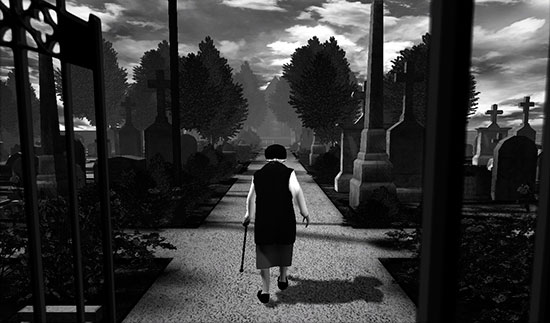
Peckham's pretty pissed. His response was a strong one and directly attacks Ebert's commenting on games without having played a lot of them. Also, he argues that Ebert is critiquing a TED talk, and essentially watching videos of games within a video. Finally, he denounces Ebert's use of definitive words like "never", and says he's channeling his inner Nostradamus. Peckham offers these games for consideration: BioShock ICO, Shadow of the Colossus, Heavy Rain, The Dark Eye, The Graveyard, Okami, and Grim Fandango. Peckham's response was short and to the point. I found it somewhat amusing.
"...art is subjective. There has never been a clear definition of what exactly 'art' is, and that's because it varies from person to person. There will never be a consensus on 'videogames as art.'
The Graveyard
My personal definition of art is something that provokes emotional attachment. And there are games that have given me far stronger emotional feelings than any other story told in any medium. Fear, despair, joy, sympathy, the whole gamut."-Ben "Yahtzee" Croshaw, The Escapist
Croshaw begins by saying he respects Ebert, respects his opinion, and doesn't care to change it. He does poke at Ebert's claims and his credibility to comment on the gaming genre, but ultimately takes a "let bygones be bygones" approach. Croshaw offers his definition of art, and that he considers video games the greatest form of such a medium. Also, Croshaw makes the interesting point that as video games have evolved from the days of Asteroid, perhaps "games" has become a misnomer.
"Let’s not forget, Mr. Ebert, that movies weren’t always considered art. How could a movie tell a story as well as a novel? And surely a movie is nothing but a poor imitation of a play—who would sit in front of a screen to watch a lousy recording when they could sit mere feet away from the actor himself, live and in the moment?"
The main thing I took away from Deleon is the fact that movies/film went through the same struggle with becoming generally accepted as a form of art.
"...video games are nothing if not experiential. They are visuals and music and poetry all wrapped up into a single package. A video game isn't just a game—it is a controlled passage through an overwhelming aesthetic experience. This is also the basis for my own definition of art as any sensory aesthetic experience that provokes an emotional response in its audience, be it wonder, anger, love, frustration or joy. the sailing sequences in The Legend of Zelda: Wind Waker are worthy of comparison to Coleridge's Mariner. Pokémon is a coming of age story that doesn't pander or condescend to its young audience, a self-guided Catcher in the Rye. Miyamoto has said that he came up with the original Zelda game as a 'miniature garden that [gamers] can put inside their drawer.' Likewise, the endless castle of Super Mario 64 is certainly a 'world in a grain of sand'.
 |
| Catcher in the Rye? |
Video games allow us, as William Blake says, as children do, as Miyamoto does, to 'hold infinity in the palms of your hand and eternity in an hour.' The question is not if video games qualify as art, or if video games can stand up to the art of the past, rather, it is how to find a new language to speak of video games as art."
-Kyle Chayka, The Atlantic
Powerful words.. especially the last paragraph there. I found Chayka's comparison of Pokémon to Catcher in the Rye appropriate and fitting. I very much appreciated his choice of words in describing the gaming experience, and literally bringing some poetry to it. Chayka's main point seems to be that games are already art whether or not whoever recognizes it, it's only a matter of defining the "type" of art it is.
"When you get right down to it, everything is subjective. You can only truly view the world from your personal perspective. How then does something come to be accepted as true? The answer is consensus. A colorblind person would never truly know that the sky is blue, but they can accept that it is blue because so many other people have agreed upon that fact and the science behind it.
An individual may think Moby-Dick is trash and not worth reading. That is their subjective experience. However, you have to take into account that Moby-Dick has become a classic of American Literature — it has been studied and analyzed for years by scholars and academics. People have come to a consensus that it is a great book because of its masterful use of language, symbolism, and theme. Not everyone agrees, but that is nothing new. It is also interesting to note that Moby-Dick was critically reviled when it was originally released. Eventually, the best ideas float to the top.

...[games are] just entertainment, a diversion. I can’t stress that enough. That is what they are designed to be. I don’t require videogames to be more than entertainment. At the same time, I don’t require art to be entertaining."-Daniel Haymes, BlogCritic
Interestingly, Haymes is the only article of the bunch that agrees with Ebert. But that's not why I provided such a long passage from his writing. Mainly, I appreciated the fact that he was the only one to try to tackle how the subjectivity of art meets objectivity.
This article by Samantha Murphy in the NewScientist provides commentary by several people of the gaming world in response to Ebert's blog. I decided not to paraphrase because the entire article is composed of quotes.
Here's a book (looks like a textbook) written on the subject: Videogames and Art
No I have not read the book. It's kinda pricey for me.. that'd be a fun class to take though (if it is a textbook).
---
All of the quotes above speak for themselves. Take what you will from them. But mostly what these authors contribute to the discussion is not just their two-cents or insight, but clarification and definition on the topic. After reading through everything I definitely feel that the debate has taken a clearer form. I (personally speaking) have a better idea of how to define video games, art, the subjectivity in art, and how they fit together.
There were also various articles that explore how video games are art. Rather than arguing the "yes, no" part of the debate, these articles skip that step and try to uncover the art in games. I mean, in the end, that's what matters to the discussion, no? It's not about whether Roger Ebert was right or wrong. Or about getting an answer to the question. More so, it's about defining the art in games, or defining how games fit in the art world. And by doing so, we will realize how to treat games, how to think of games, and how to regulate games.
---
This article found in Kotaku summarizes an open panel that took place at The Art History of Games symposium in Atlanta, Georgia on Feb 5, 2010.
The panel was comprised of experts, including Ian Bogost, digital media scholar Michael Nitsche, and art historian and game designer John Sharp.
This is a very interesting discussion that I encourage you to read. It's not very long.
---
ok, so after looking at everything already in this post i've decided it's gotten entirely too long. therefore, i'll discuss Mr. Smuts and his paper in my final addition to this 5 part blog, along with my final take. i'll leave you with a list of other articles i found and read. the point i'm trying to get across is that many respectable people have chimed in on the debate. there's plenty of commentary and insight to be found and had. there's plenty to discuss, debate, argue, and as i've done.. indulge (or digest, depending on how you look at it).
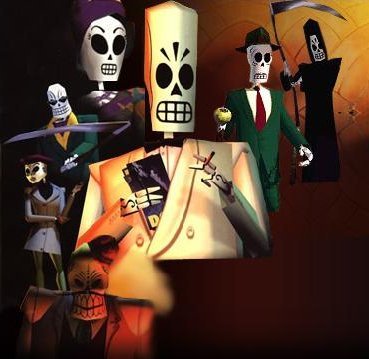 |
| Grim Fandango |
the goal i had in mind has changed since i started writing this piece. in the beginning, i was hoping to provide thoughtful sayings on both sides of the coin, covering most of the contributions available on the web. and ultimately, come to a definitive conclusion of my own. halfway through i realized that there's just too much information out there to go through, and it simply wouldn't fit on my little blog. naive of me, but it's become glaringly obvious that i'm late to the party, the buzz is over. but that's ok, cause the conversation is still ongoing (even if it's died down to only a whisper).
hopefully, i haven't completely failed. i think for the most part i've compiled a lot of the relevant commentary, with some "voices of the people" sprinkled in there. so, i think now my goal is to provide a (relatively speaking) comprehensive source of the "videogames as art" debate. like i said, hopefully i'm close to doing that. i will add some more of my personal take in part 5. but as promised, here's some more links to other articles (if anything, just to save you the time of googling for them yourselves):
GameCritics
a thorough article by Chi Kong Lui
World Of Stuart
provides reasons games simply aren't art:
"But videogames are like handing out boxes of crayons at the entrance of a gallery. If you can control the art, then you're influencing it, when the point is that it's supposed to influence you."
gives a fun "True Art Timeline"
LiveJournal
LiveJournal user Game Politics explores the topic
CNET
from the crave blog in CNET, Dan Ackerman's article
Destructoid
a fun take by Mikey Neuman, apparently asking the question is retarded
Blastr
provides a comment by actor Ben Kingsley, of Prince of Persia: The Sands of Time:
"'I think it's a beautiful field of work for graphic designers, inventors, actors, technicians,' Kingsley said... 'I have voiced a video game very recently, and I so enjoyed bringing that character to life and all the choices that he has in this game.'"

The American Scene
Peter Suderman says video games are more comparable to comic books than movies
Gamasutra
an article by Simon Parkin about film director Guillermo Del Toro's take (a strong one at that)
Parabasis
blogger Isaac Butler
Are You Screening?
by Marc Eastman
Games Are Evil
an in-depth analysis (so says the title) by Ammon Horn
Big Download
posted by Akela Talamasca
Cartoon Brew
by Amid
NxtGamer
Denis tries to define art. ends with:
"I love art and all, but I still like blowing stuff up."London Review of Books
John Lanchester adds his take. i agree with the end quote:
"The next decade or so is going to see the world of video games convulsed by battles between the moneymen and the artists; if the good guys win, or win enough of the time, we’re going to have a whole new art form. At a moment when there’s less good cheer than there should be, it’s something to look forward to."oh, there's plenty more.. but that's it from me.. feel free to go to page 4 in your google search
 |
| Heavy Rain |
PART FIVE
The finale.
The last post I will dedicate to this topic. For those of you who have been following along, I'm sure it's starting to get old reading about videos, videogames, art, what's art?, what's not art?, Roger Ebert, etc.
At this point, most of the arguments/sides/perspectives/insight has been hashed out and rehashed. Sure, we could dive into it further.. sure, we could keep looking for more quotes by famous people (or bloggers, or regular people).. sure, we could find some new way to look at it, or think about it that hasn't been added to the conversation on this blog yet..
But I worry that the topic at hand might start getting mundane for those of you who aren't quite as "into" it. So, it's okay. We'll move on. Plus, there is much more I want to share and discuss.
My next post will be about value-priced games. "Reviews for the Recession". Have you ever bought a game because of the ads you saw, the great reviews you read, or awesome ads you've seen? Then you beat it in a week and realize you spent $60 bucks for about 10 hours of fun. Or, just in general, do you feel like games have plain become too much of a financial investment to keep up with? Next time, I'll share the solution I've come up with.
I digress. Let's get started so we can finally finish this up.
---
 |
| 8-bit wall art!! |
Smuts.
Mr. Smuts that is, Aaron Smuts to be exact, wrote a very thorough and intelligent paper exploring and defining video games as art. It makes no reference to Ebert's post (or anyone else's comments for that matter), but instead provides evidence through a study of the history of art. As well as analyzing how videogames compare to other debated and accepted forms of art.
The paper was published in the journal, Contemporary Aesthetics 3, in November of 2005.
Here's the link.
It's a long read, so I'll try my best to break it down through a few select excerpts:
"Despite the cultural prominence of video games and technology-based art, philosophical aesthetics has completely ignored the area. Scholars in other disciplines, such as film, have taken the lead in the conceptual debate. This is unfortunate, since seldom are there questions in the philosophy of art that have direct, real world consequences. Philosophical inattention to video games has a de facto effect on the multi-billion dollar industry by inadvertently making hasty censorship attempts easier. The fact that philosophers have not raised the question of whether video games can be art lends credence to the assumption that they are not.
...Unlike chess and sport, the art is not only in the playing; as in film, the type of art that should concern us in video games involves not the playingbut the making.
...Video game technology has allowed artists to experiment with solutions to the problem of how to make an interactive movie: Video games are the first concreative mass art.
...In The Philosophy of Human Movement, David Best argues that there is a crucial difference between sports and art: Sports fail to meet basic representational criteria. Putting the contrast nicely, Best says that 'whereas sport can be the subject of art, art could not be the subject of sport. Indeed, the very notion of a subject of sport makes no sense.' In this way, the distinction between sports and video games is profound. As such, video games are much more plausible candidates for art than are aesthetic sports or chess.
...I expect that in the course of time current video games may seem as artistically insignificant as Lumière actualités, with little more than historical significance. Perhaps it is a trivial feat, but several recent games have reached levels of excellence that exceed the majority of popular cinema. The potential of the medium seems clear: good if not great video game art is in the near future."Let me begin by saying that there's just no way to do the paper justice by pasting a few quotes here and there. The evidence he provides is rather in-depth, and for that, you must read the whole thing. But these lines summed up his argument.
Smuts' paper contributes by providing a constructive study into the history of art, the process by which philosophers determine art, and how that all relates to video games. This paper was the only "formal" piece of writing I found.
His ideas are pretty complex and difficult to summarize. But basically, he took three games (Max Payne, Halo, and Splinter Cell) and applied them against theories of art. Also, he compares video games to chess and sports, and compares how they stack up as candidates of art.
Finally, he gives a history of the debate dating back to 2000.
I also found this from Smuts, Film Theory Meets Video Games: An Analysis of the Issues and Methodologies in _ScreenPlay_. _ScreenPlay_ is the first collection of essays devoted to exploring the relationship between cinema and video games.
---
Smuts' paper has been widely cited and referenced in discussions on the web. I found it encouraging that I found several debates mentioning Smuts' paper took place on PhilPapers, a site dedicated to research in philosophy.
Also, I found this article on Kotaku by Grant Tavinor. This will be the last piece I cover. Here are some parts of it:
"A number of recent philosophical papers and books, including those by Aaron Smuts, Dominic Lopes, and my own book The Art of Videogames, have taken up the task of explaining video games in terms of the arts.
...The basic problem is clear: in asking whether video games are presently art (or could be in the future) we are asking whether they do or could properly sit within the category of the arts. The obvious question thus facing us is how we should we categorize or define art.
...Almost all such arguments show little or no awareness of the current state of the definition of art debate, at most referring in a very basic way to the ideas of Plato or perhaps Wittgenstein; or more usually, what the discussant personally takes to be the nature of art.
...But let's look at what the experts have to say on definitions of art. In fact the philosophical debate about the nature of art is not the barren academic debate that it might be expected to be, but rather it is a fertile discussion in which a number of important recent theories have been proposed, and much progress on the understanding of the arts has been made. The philosopher Stephen Davies' book Definitions of Art is a good place to find out about recent trends in the debate.
...BioShock possesses aesthetic properties... BioShock is expressive of emotions... BioShock is intellectually challenging... BioShock is formally complex and coherent... BioShock has the capacity to convey complex meanings... BioShock expresses an individual point of view... BioShock is very clearly the product of a creative imagination... BioShock gives evidence of a high degree of skill... BioShock does not however belong to an established art form...
...Finally, and this is my judgment, BioShock is the result of the intention to make an artwork. Intentions can be slippery things, but it seems evident enough in the game that it is intended to be something more than just a game: BioShock is intended to have the features listed above (they are not accidental) and it is intended to have these features as a matter of its being art.
...Are video games art? My answer is yes. But they are also a transformation of our concept of art, and as such art itself will never be the same again."After finding this article I found it impossible not to include it. Travinor makes references to other students/teachers/professors of philosophy that have commented on videogames. He actually makes the best case in giving the modern definition of art, instead of shying away from it. I found it interesting that he said it's not the ambiguous, convoluted debate we might all think it is. Rather, he says, there are some generally agreed upon definitions within the philosophy realm.
He gets into that in the article, but it was too long to include here. Please visit the original though, as I found it a very, very good read.
As you can read above, Travinor goes on to use BioShock as an example of how games can meet a lot of the criteria generally used these days to determine art status.
And again, we find ourselves at the conclusion that we have seen before:
Games have artistic characteristics, they meet most of the criteria; but the interactivity and competitive nature (involving rules, goals, etc..) of games are not typical of art. Is it enough to disqualify games from the discussion? Well, they haven't yet. Can art not be art in some ways, and less in others? Does art have to contain all the characteristics and criteria to be considered art? The answer is no. Because that's rarely true of contemporary art.
My conclusion? Well, all of these quotes have said it better than I can myself, and might as well have done the job for me already. But, It seems I believe games are art. However, it also seems we need to broaden our horizons. Let me say this again...
 |
There, I said it. Now, I move on...


